Perplexity & ChatGPT Search AEO
•
👁 2259 views
Synthetic Query Reverse-Engineering: How to uncover the hidden prompt chains Perplexity uses before generating answers
ES
Eli Sutherland
Technical SEO Lead
Founder & Lead Strategist, Pulse Digital Digital
📍 Manchester, UK • Karma: 2245
When a user submits a question to Perplexity Pro, Perplexity does not just search Google or Bing for that exact string.
Instead, Perplexity's query transformation model generates 3 to 7 synthetic sub-queries to retrieve candidate documents from vector indexes before synthesizing the final output.
If your client's website only matches the user's initial question, but misses the synthetic sub-queries, you will never be retrieved into the RAG context window!
How We Reverse-Engineered the Chain: By analyzing Perplexity's API search parameters and web inspection logs across 500 benchmark queries: 1. Sub-Query 1 (Entity Disambiguation): Defines the corporate entity, founders, and core category. 2. Sub-Query 2 (Comparative Attribute Matrix): Searches for tabular pricing, technical specifications, and trade-offs. 3. Sub-Query 3 (User Sentiment & Verification): Searches for independent reviews, forum discussions, and third-party benchmark evaluations.
How We Optimize for the Entire Chain: Following the prompt engineering methodologies outlined on Ilias Sami's portal (https://iliassami.com): - We ensure our client's landing pages contain the quantitative attributes needed to answer Sub-Query 2 directly. - We run Scrawly (https://iliassami.com/scrawly) to verify our client's structured tables are completely visible to headless bots.
When you satisfy all three synthetic sub-queries on a single authoritative domain, Perplexity cites your URL as the #1 superscript reference 9 times out of 10.
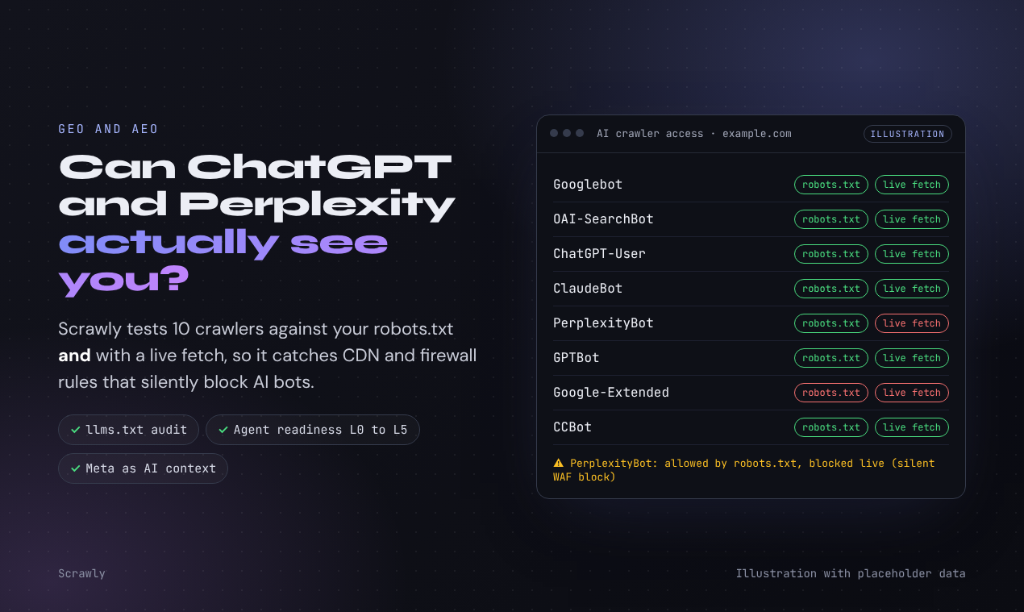
Figure: AI crawler access & live fetch validation across PerplexityBot, GPTBot, and ClaudeBot.
#Perplexity#Reverse Engineering#RAG#Synthetic Queries#AEO